
Ultrafine pulverization
Critical process selection
The particle size of a material is the most important physical indicator that affects and determines its performance in end use applications. Crushing is currently the most commonly used key process to achieve the desired particle size. With the continuous expansion and deepening of material applications, achieving stable and efficient acquisition of ultrafine particles has become an important goal in the preparation process of many advanced materials. Fentek's process experts are well versed in the core mechanism of ultrafine grinding. Combining our rich application experience for different materials, we will help you choose the most suitable ultrafine grinding process for your goals to achieve high-quality material production.
Scalable, continuous production process: Efficient synthesis with less by- and waste products
Production of Our Lithium Iron Phosphate
For more than 10 years IBU-tec has been involved in the development and production of LFP cathode material. The starting materials first pass through spray drying, are refined in a rotary kiln and then milled: an excellent production performance with high quality.
Fluidized bed airflow mill
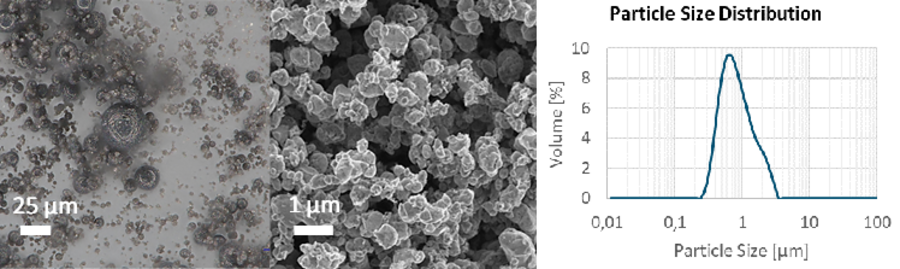
Fluidized bed airflow mill is currently the most advanced dry crushing technology for micron to submicron sized particles, typically reaching particle sizes ranging from 0.5 microns to 50 microns. In this type of air flow mill, an air flow with pressure and temperature is introduced into the grinding chamber, which drives the high-speed movement of raw material particles and generates collisions between particles, thereby producing a crushing effect to reduce particle size. Based on this mechanism, there is no collision between particles and any mechanical components in the crushing process of fluidized bed airflow mill, effectively avoiding mechanical component wear and subsequent product pollution caused by particle and mechanical component collision in other crushing processes. In addition, the fluidized bed airflow mill is equipped with a dynamic air classification wheel, and users can flexibly and quickly obtain products of different particle sizes by adjusting the speed of the classification wheel.
| IBUvolt® LFP400 | IBUvolt® LFP402 | |
| Particle size d50 [µm] | 11.1 | 1.2 |
| Tamped density [g/cm³] | 1.0 – 1.4 | 0.6 – 0.9 |
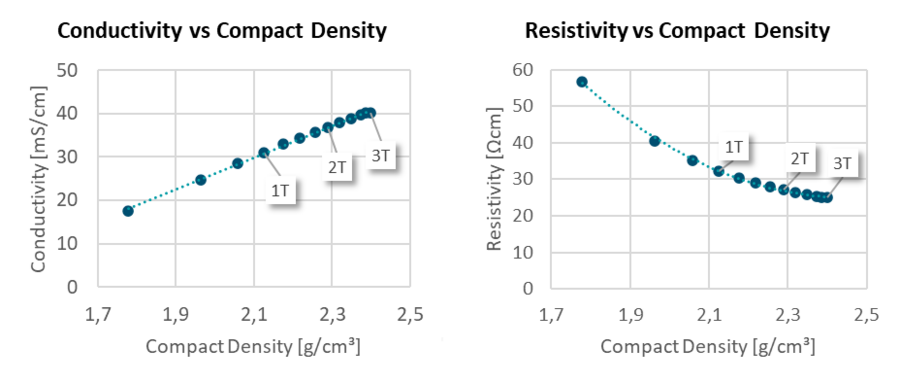
| Electrode density [g/cm³] | 2.3* | ≥ 2.5* |
| Specific capacity [mAh/g] | ≥ 149 | ≥ 159* |
| Data sheet | Download |
advantage
- Accurate maximum particle size control, no unqualified coarse particles
Narrower particle size distribution of finished products
Extremely stable product batch results
Single machine high production capacity
The crushing process has no temperature rise and is suitable for heat sensitive products
Can crush all hardness products
Extremely low impurity introduction
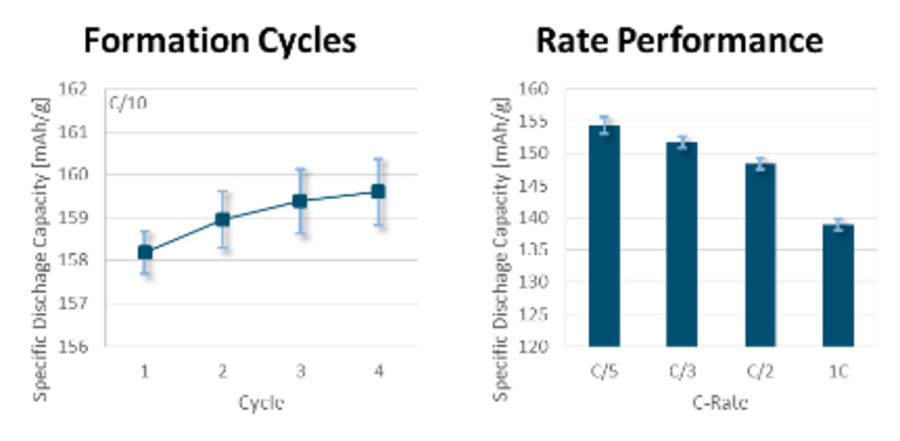
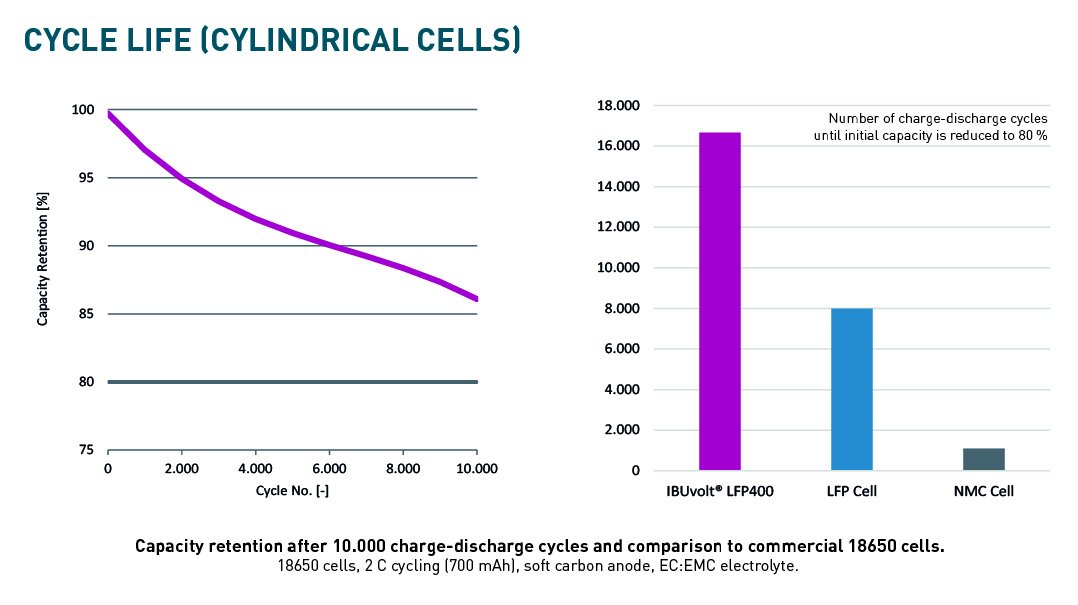
IBUvolt® LFP400 – Long Life and Cycle Stability
For more than 10 years IBU-tec has been involved in the development and production of LFP cathode material. The starting materials first pass through spray drying, are refined in a rotary kiln and then milled: an excellent production performance with high quality.
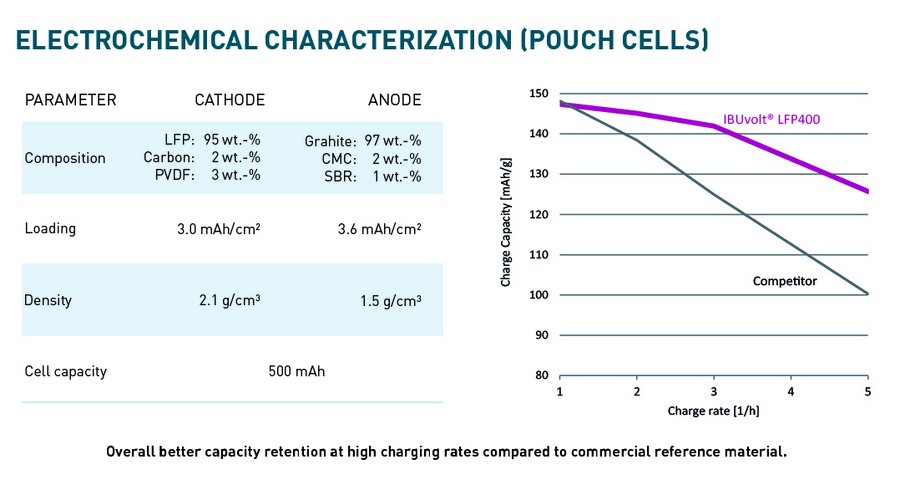
Rotor impact grinding
The rotor impact mill is one of the most widely used fine crushing devices, which can cover a particle size range of usually around 30 microns to 2 millimeters. The grinding rotor and stator inside the impact mill can be flexibly designed and quickly switched according to different applications and requirements. After entering the mill, the particles to be crushed move at high speed under the drive of the rotor, and are crushed into suitable particle size under the action of impact force, shear force, and friction force. Different stator/rotor structures, rotor operating speed, and matching with downstream process equipment will have a direct impact on the final crushing effect.
Compacting Properties
For more than 10 years IBU-tec has been involved in the development and production of LFP cathode material. The starting materials first pass through spray drying, are refined in a rotary kiln and then milled: an excellent production performance with high quality.
Background on Lithium Iron Phosphate Batteries
Energy storage systems are a valuable key technology for not having to rely on the use of fossil raw materials for energy production and being able to use other sources, such as wind power and photovoltaic systems. Currently available storage systems are largely based on the proven lithium-ion battery technology. Lithium-ion batteries consist of four basic components that make up the battery's cells: Cathode, Anode, Separator and Electrolyte. IBU-tec has many years of experience in the production of lithium iron phosphate cathode material (LFP or LiFePO4).
When charging a lithium-ion battery or lithium-ion accumulators, lithium ions are transported through the electrolyte layer from the cathode to the anode. In the anode, which is often made of graphite or other carbon-rich materials, the reversible
ntercalation of the lithium takes place with the absorption of electrons. When the battery is discharged, this process is reversed. The lithium-rich anode layer releases electrons and the resulting lithium ions are transported to the cathode. The resulting current flow can be used by electrical consumers. This cycle can be repeated several times in rechargeable batteries, although certain memory effects are inevitable. The higher the quality of the battery and the materials used in it, such as lithium iron phosphate, the longer the service life can be.
Lithium iron phosphate is becoming increasingly important as a cathode material in modern batteries. Depending on the end application and field of use – be it in the field of e-mobility or in stationary energy storage – different requirements arise.
The designation LFP is derived from the empirical formula LiFePO4. LFP cathodes are free of the heavy metal nickel and the critical raw material cobalt. Compared to other cathode materials, LFP also shows advantages in durability and safety.